Week 2: Industry Today

Updated: Aug 5
Design is an ever-evolving field that draws inspiration from a numerous number of sources. Throughout time, this has aged from generation to generation, varying in ways of communication to being more digitally grown in today's design world.

To answer more about what makes today's industry, at least to me, I see it in the form of many tools and talents. It's not just used as simply one tool but as a plethora of functions. From compositional, traditional art on a canvas to a more deep technological brush, this is all digitalized these days.
For example, when designing an image instead of grabbing a paintbrush, such as a more traditional artist would, I use a variety of Adobe Creative Suite tools in my arsenal. This affects the image's logo design, layout, typography, and even the after-image effects such as lighting. This is in the form of different programs such as Photoshop, Illustrator, and Lightroom.
It's been such a blessing to design in an era where all of this is accessible with the internet and a subscription and, wa-la, a whole world of creative possibilities.
Lecture
Susanna Edwards spoke with a former colleague and tutor at CSM, Mazar Raien. It was interesting to see their take on the advancements from the early days of graphic design as a whole. Where there was a combination of different influences, production, and more transformation. Not to mention the rise of culture throughout the generations, specifically in the era Mazar grew up in, the 80s. There were figureheads, but it hadn't bloomed into full independence in terms of design. With time, there became terms and tools we use today: logos, branding, and identity, etc.
Mazar described it as a 'one size fits all' mentality back then.
The role of the graphic designer used to be much more 'prescribed'; by the time the computer came to arise, it made us the first generation to think of the idea and oversee the production technologically. We oversee our own products coming to life.

They brought up the aspect of knowledge of depth as a designer. Today, there are so many different ways to obtain this, and with technology the younger generation has lost this path. To obtain it, it requires elements of interviewing and actually speaking with individuals, going to libraries, insights, etc. It's important, but with computers and such, it's somewhat of a dying way of learning design.
I agree 100% with what they're speaking about here. In an era where technology and AI remain a rising problem, the ease of access is like any other. Especially in terms of learning and communication. I've tried my very hardest as an individual freelancer to learn from established designers in my industry, including the likes of Michael Barakat, designer at Red Bull and Louis Jones, senior designer at Two Circles. To schedule calls and conversations with individuals is so much more beneficial than a simple Google search. It's somewhat of a lost art these days. Here are some of the works that these two individuals produce:
Susanna adds tones of the enthusiasm behind Generation Z wanting to collaborate and the yearning to learn. She's excited about the boundaries to be blurred, and through this course, there's a push for new knowledge in local and global environments. From my standpoint, this is a very promising sign. I look forward to attempting to push those boundaries!
Research
Going back to my research last week, I wanted to expand on the idea of what a collage was. And how/who the artists of today are pushing that narrative forward in this new era of technology. Whomst is the modern Picasso?
Throughout my findings and digging from article to gallery page and more, I found a modern-day artist whose unique style stuck out to me the most: Jesse Treece. A modern-day collagist and artist based out of Seattle, WA. His works combine the use of vintage magazines and books to create works that bring surreal and an 'inimitable perspective on everyday life.'

One piece that stuck out to me the most was Mountains Between. Which truly gives the visual on these scenic stacking mountains, almost as if you can see each layer cut out slice by slice. It provides an extremely unique perspective, giving it a scrapbook-type feel. I'm obsessed!
When asked about why he started, he stated...
I don't really know! I started making them in late 2009 after burning out on trying to write songs and it just seemed to come naturally to me. I felt there was a lot I could explore with the medium.
A completely relatable statement if you ask me; burning out from one medium and exploring to a new dimension is something I've become akin to as a designer. To wear multiple hats and to explore different themes is crucial. Seeing that this statement came in 2014 from the man himself and he's still selling and creating art in galleries alike, it seems like it's worked out for him!
Really inspiring stuff.
Task
For this week's task, I was requested to..
Select a design business that you admire, which is located close to where you are based. This might be a traditional design studio / agency or it could be a place for design production such as a commercial printers, web development company or traditional signwriters.
Collect a link to their website, describe what they do in one or two sentences and geotag the location through the platform on the next page.
For this task..I decided to come back and change my answer from what I had originally chosen on the map prior. This being Guerilla FC based in Washington DC. They're a collective of creative individuals within the DC soccer scene from a variety of backgrounds. From videographers, photographers, designers, and even employee's at Under Armour. They run not only monthly events for soccer, but are heavily involved in the fashion scene as well. Producing kits, clothing lines and more.
Here is their most recent collection.
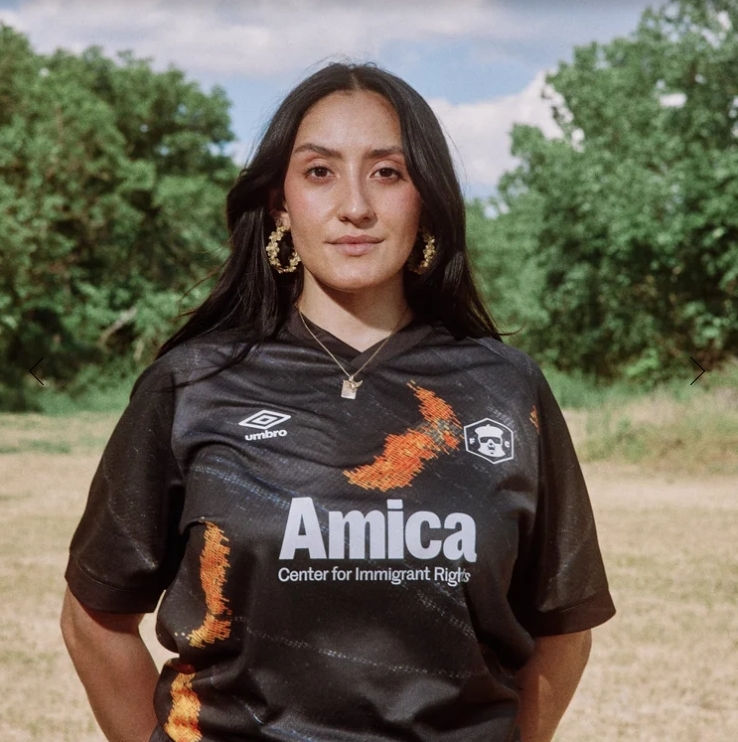
The team as a whole has been super welcoming, and they're an amazing group of individuals. I've actually had the chance to develop a poster for one of their monthly matches, and with clothes that represent such great causes such as Amica as seen above, it's hard not to like them!
References
Baker, H. (2014). Top 10 Collage Artists: Hannah Höch to Man Ray. In AnOther Magazine. https://www.anothermag.com/art-photography/3318/top-10-collage-artists-hannah-hoch-to-man-ray
Seymour, C. (2019). Ray Gun Lives Again. In Vogue. https://www.vogue.com/article/ray-gun-magazine-anthology
Instagram. (2026). Instagram.Com. https://www.instagram.com/p/DQcQZtgj3Si_9r1rxbmmRIlIW-7tE1tXp1ZsCU0/?img_index=4
ART: INTERVIEW WITH JESSE TREECE | Brunch & Brains. (n.d.). In ART. https://brunchandbrains.blogspot.com/2014/04/artist-interview-jesse-treece.html
Brodie, K. (2025). Graphic design trends 2026. In Author Hub. https://author.envato.com/hub/graphic-design-trends-2026/
Louis Jones on Instagram: “The Tartan Army are in Miami 🎨 ✍️ It’s crunch time // @scotlandnationalteam 🏴 🇧🇷 #smsports #fifaworldcup #graphicdesign #brazil #tartanarmy.” (2026). Instagram. https://www.instagram.com/p/DZ-8rSzo3De/?hl=en
ART: INTERVIEW WITH JESSE TREECE | Brunch & Brains. (n.d.). In ART. https://brunchandbrains.blogspot.com/2014/04/artist-interview-jesse-treece.html
SS26 monarch collection by Guerrilla FC x Amica Center. guerrilla fc. (n.d.). https://www.guerrillafootball.club/shop


Comments